

Finding the Right Makita Reciprocating Saw 18V for Your Work
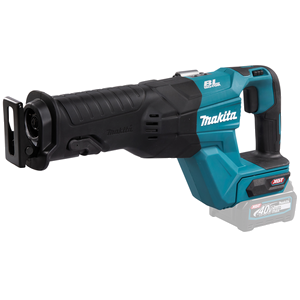
The right saw really comes down to the materials you're working with and how often you'll be reaching for it, which is where Makita's 18V LXT range makes a lot of sense for tradespeople who already have compatible batteries in their kit. A makita reciprocating saw 18v gives you the flexibility to move between cutting timber, metal, plastics and pipework without having to worry about finding a nearby power supply, while the different body sizes and motor configurations mean there's something to suit both heavier demolition and more confined working areas. Whether you're after a compact saw for awkward cuts or a full-size model that can handle more demanding applications, the 18V range gives you plenty of options without needing to move onto a completely different battery platform.
Why Professionals Choose a Makita Brushless Reciprocating Saw
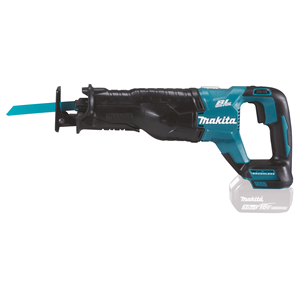
One of the biggest things worth considering when comparing these tools is the motor, particularly if you're going to be using your saw regularly throughout the working day. A makita brushless reciprocating saw uses an electronically controlled motor rather than traditional carbon brushes, reducing friction and making better use of the battery's available power, which can mean longer run times and less heat build-up during demanding applications.
Models such as the DJR187Z and DJR188Z are good examples of where this technology makes a difference, with their brushless motors providing consistent cutting performance alongside variable speed control, allowing you to adjust the stroke rate depending on what you're working with. This is particularly useful when you're moving between softer materials and tougher applications, as having greater control over the cutting speed helps you work more comfortably without putting unnecessary strain on the tool. For anyone who regularly tackles strip-outs or heavier cutting work, brushless is well worth considering.
What Can You Use a Reciprocating Saw from Makita For?
A reciprocating saw from makita is one of the more versatile additions to a professional toolkit, mainly because of how many different materials and applications it can handle with the right blade fitted. They're particularly useful during renovation and demolition work, where you might find yourself cutting through nail-embedded timber, removing sections of plasterboard or working around existing structures where a more conventional saw would be difficult to manoeuvre.
They're equally useful for tradespeople working with pipework and metal, as the correct blade allows you to cut through steel pipes, conduit and aluminium framing without having to reach for a separate cutting tool. Plumbers can use them when altering existing pipework, electricians when working with conduit and builders when stripping out old structures, making them a practical option when the job involves a bit of everything. Add in Makita's tool-less blade changing system on compatible models, and switching between applications becomes much easier when you're working against the clock.
Compact vs Full-Size: What's the Difference?
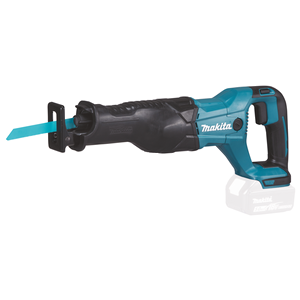
Choosing between a compact and full-size saw isn't necessarily about which one is more powerful, but rather where you're going to be using it and how much room you have to work with. Full-size models such as the DJR186Z and DJR187Z are designed with more demanding cutting applications in mind, offering a longer stroke length and the cutting speed needed when working through thicker materials or carrying out heavier demolition. They're a good option when you have enough room to get a proper grip on the tool and need consistent performance across larger jobs.
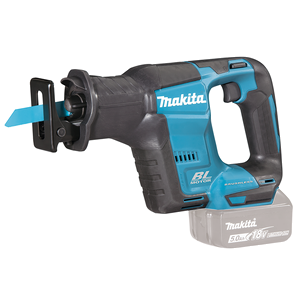
Compact models such as the DJR188Z take a slightly different approach, with a shorter body that makes it easier to manoeuvre around awkward spaces, overhead sections and areas where access is limited. This can make a noticeable difference when you're working between joists, around pipework or in confined areas where a full-size saw would feel a little cumbersome. Both styles are designed with site work in mind, and selected models also feature Makita's eXtreme Protection Technology (XPT), which helps improve resistance to dust and moisture when working in tougher conditions. Ultimately, it comes down to whether cutting speed and heavier applications or accessibility and manoeuvrability are more important for the work you carry out.